


A 95% yield on a 2-litre benchtop reactor is a genuine achievement. The chemistry is validated. The biology is robust. Every parameter is documented. Then the process moves to a 20,000-litre commercial vessel - and yield collapses to 80%. Fifteen percentage points disappear without a single change to the recipe. This is the Wall of Confusion: the systemic failure that occurs when a proven benchtop process encounters the fundamentally different physical environment of commercial-scale manufacturing. It is not a chemistry problem. It is a physics problem - and it demands a physics solution.
Why Scale-Up Causes Yield Loss (The Wall of Confusion)
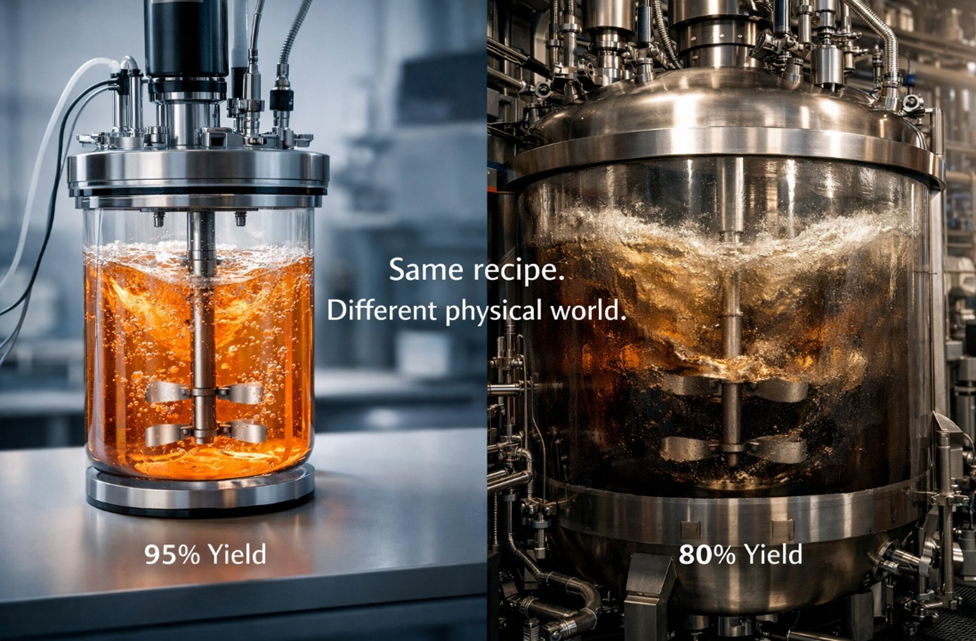
The Wall of Confusion describes the breakdown in process fidelity that occurs during tech transfer from laboratory development to commercial production. Laboratory reactors create a near-homogeneous environment in which mixing is achieved within seconds and mass transport is essentially instantaneous. Commercial vessels, by contrast, are complex, heterogeneous systems in which concentration gradients persist for minutes, shear forces vary dramatically across the vessel volume, and gas transfer efficiency is frequently compromised by unfavourable hydrodynamics.
When benchtop data is passed - typically as a static validation report - to MSAT engineers responsible for commercial manufacturing, the physical mismatch between the two environments is rarely accounted for. The result is batch failure, regulatory scrutiny, delayed product launches, and significant financial loss.
Why Geometric Scaling Fails in Process Intensification
For decades, engineers have relied on geometric scaling rules to transfer processes from laboratory to plant scale. The three most common approaches - maintaining constant impeller tip speed, preserving power-per-volume (P/V) ratios, and scaling vessel dimensions proportionally - share a common and critical flaw: they assume that fluid behaviour scales linearly with geometry. It does not.
At laboratory scale, the rate-limiting step is reaction kinetics. At commercial scale, the rate-limiting step shifts to mass transport - how efficiently molecules, gases, and nutrients physically move through the fluid. Geometric rules cannot account for this transition.
- Constant tip speed creates stagnant dead zones and persistent concentration gradients.
- Constant P/V generates localised shear stress sufficient to lyse cells or denature sensitive molecules.
- Proportional geometric scaling ignores the non-linear physics of large-volume fluid dynamics entirely.
The Three Process Metrics That Solve Scale-Up Failure
Process intensification replaces geometric intuition with three precisely defined physical metrics that quantify what cells and molecules actually experience inside the reactor - at any scale.
Metric 1: Energy Dissipation Rate (EDR)
EDR quantifies the exact power per unit mass dissipated by turbulence, expressed in watts per kilogram (W/kg). It provides a direct measure of the shear stress experienced by cells or molecules -replacing the outdated and imprecise practice of specifying impeller tip speed or RPM.
Shear stress operates within a narrow productive window. Excessive shear lyses cells and denatures proteins. Insufficient shear leaves the vessel poorly mixed, producing concentration gradients that drive side reactions and reduce selectivity. By calculating and matching EDR between benchtop and commercial scale, engineers ensure that biological entities experience an identical physical environment regardless of vessel size - eliminating one of the most common hidden causes of commercial yield loss.
Metric 2: Volumetric Mass Transfer Coefficient (KLA)
KLA measures the rate at which a gas - most commonly oxygen -transfers from the gas phase into the liquid phase, expressed per second (s⁻¹). It is determined not by the speed of an aeration pump, but by the physical interaction between bubbles and liquid: bubble size, coalescence behaviour, impeller-induced turbulence, hydrostatic pressure, and fluid viscosity.
A commercial bioreactor may operate with a high-specification sparger system at full capacity and still deliver a KLA less than half the benchtop target - because large-vessel hydrodynamics prevent efficient gas-liquid contact. The consequence is oxygen starvation, metabolic stress in cell cultures, and progressive yield decline. Matching KLA to benchtop values ensures that the biological or chemical reaction is never limited by gas availability at commercial scale.
Metric 3: Macro-Mixing Time (Tau)
Tau (τ) is defined as the time required for a concentration perturbation to equilibrate to within 95% homogeneity across the entire vessel volume. At benchtop scale, Tau is typically 15–30 seconds. In a 20,000-litre commercial vessel, Tau routinely extends to 3–8 minutes.
This difference has severe consequences for any process involving continuous or sequential reagent addition. At benchtop scale, each feed addition distributes within seconds. At commercial scale, the same addition creates a concentrated zone that persists for minutes - exposing cells at the feed point to potentially toxic conditions while cells in distal regions experience transient starvation. Side reactions occur. Selectivity declines. Tau makes this invisible hazard visible and provides the engineering basis for feed strategy redesign before commercial failure occurs.
Applying the Framework: Digital Fit-Gap Analysis
The practical implementation of EDR, KLA, and Tau is a structured digital fit-gap analysis - a systematic comparison of measured process metric values between benchtop and commercial scale, performed prior to tech transfer. The analysis identifies specific gaps and prescribes targeted engineering interventions: impeller geometry changes, sparger redesign, revised feed point locations, and baffle configuration adjustments.
This approach transforms tech transfer from a high-risk exercise in statistical validation to a deterministic engineering programme. Rather than running commercial batches and reacting to failures, fit-gap analysis predicts exactly where failures will occur - and eliminates them before a single commercial batch is at risk. The outcome is predictable PPQ success, on-schedule regulatory submission, and a protected product launch timeline.
Conclusion: Engineering Certainty Over Geometric Assumption
The Wall of Confusion has persisted in biotech and chemical manufacturing because the industry has historically approached a physics problem with geometric tools. Every commercial batch failure attributable to scale-up contains, at its core, an unresolved mismatch in EDR, KLA, or Tau - a mismatch that a rigorous process intensification framework would have identified and corrected before production began.
The solution is available. The metrics are validated. The engineering methodology is established. Organisations that adopt process intensification as their standard for tech transfer will eliminate commercial batch failures, secure PPQ success on schedule, and build the digital process knowledge that sustains manufacturing excellence across the full product lifecycle.
To understand how this approach can be applied in organizations, reach out to us at simsight@tridiagonal.com.